France’s commercial year revolves around Christmas, sales and back-to-school. Israel follows the Hebrew calendar, whose dates shift against the Gregorian year, sometimes by several weeks.
Copying a French advertising plan can mean arriving too early, too late or during a holiday when nobody buys. Franco-Israeli businesses juggle two overlapping calendars, with different peaks and quiet periods.
Here is the advertising calendar from September 2026 to autumn 2027, the key dates and how to prepare each peak.
Why the Hebrew calendar changes everything
Three features explain why imported plans fail.
-
Holiday dates move. The Hebrew calendar is lunisolar. Rosh Hashanah fell on 12 September 2026 and falls on 2 October 2027, three weeks later. Year 5787 has an extra month, pushing Passover to 22 April 2027
-
Holidays start the evening before. A holiday dated 22 April starts at sunset on the 21st. Order and delivery deadlines must reflect that
-
Israel and the diaspora follow slightly different schedules. Passover lasts seven days in Israel and eight in the diaspora; Shavuot lasts one day in Israel and two abroad
Add Israel’s Sunday–Thursday week, shorter Friday and Shabbat. A retailer promising delivery “before the weekend” must know which weekend it means.
The 2026–2027 calendar at a glance
| Key event | Dates | Importance in Israel | Importance for the community in France |
|---|---|---|---|
| Sukkot and Simchat Torah | Evening of 25 September–3 October 2026 | End of the holiday period, gradual return to activity | End of the autumn holidays |
| Singles Day | 11 November 2026 | Start of the online shopping season | Limited significance |
| Black Friday | 27 November 2026 | Major annual peak | Major annual peak |
| Cyber Monday | 30 November 2026 | Online continuation | Online continuation |
| Hanukkah | Evening of 4–12 December 2026 | Gifts and school holidays | Gifts during the Christmas season |
| Winter sales | Early January 2027, four weeks | Little relevance | French commercial peak |
| Tu Bishvat | 23 January 2027 | Dried fruit and nature | Dried fruit |
| Purim | 23 March 2027 (starting evening of the 22nd) | Costumes and gift baskets | Costumes and gift baskets |
| Passover | Evening of 21–28 April 2027 | Major shopping peak and travel | Travel, kosher food and catering |
| Yom Hazikaron and Yom Ha’atzmaut | 11 and 12 May 2027 | Memorial day followed by Independence Day | Weak |
| Shavuot | 11 June 2027 (starting evening of the 10th) | Dairy products and flowers | Dairy products |
| Summer sales | Late June 2027, four weeks | Little relevance | French commercial peak |
| Tisha B’Av | 12 August 2027 (starting evening of the 11th) | Day of mourning | Day of mourning |
| Rosh Hashanah 5788 | Evening of 1–3 October 2027 | Holiday gifts and meals | Meals, catering and gifts |
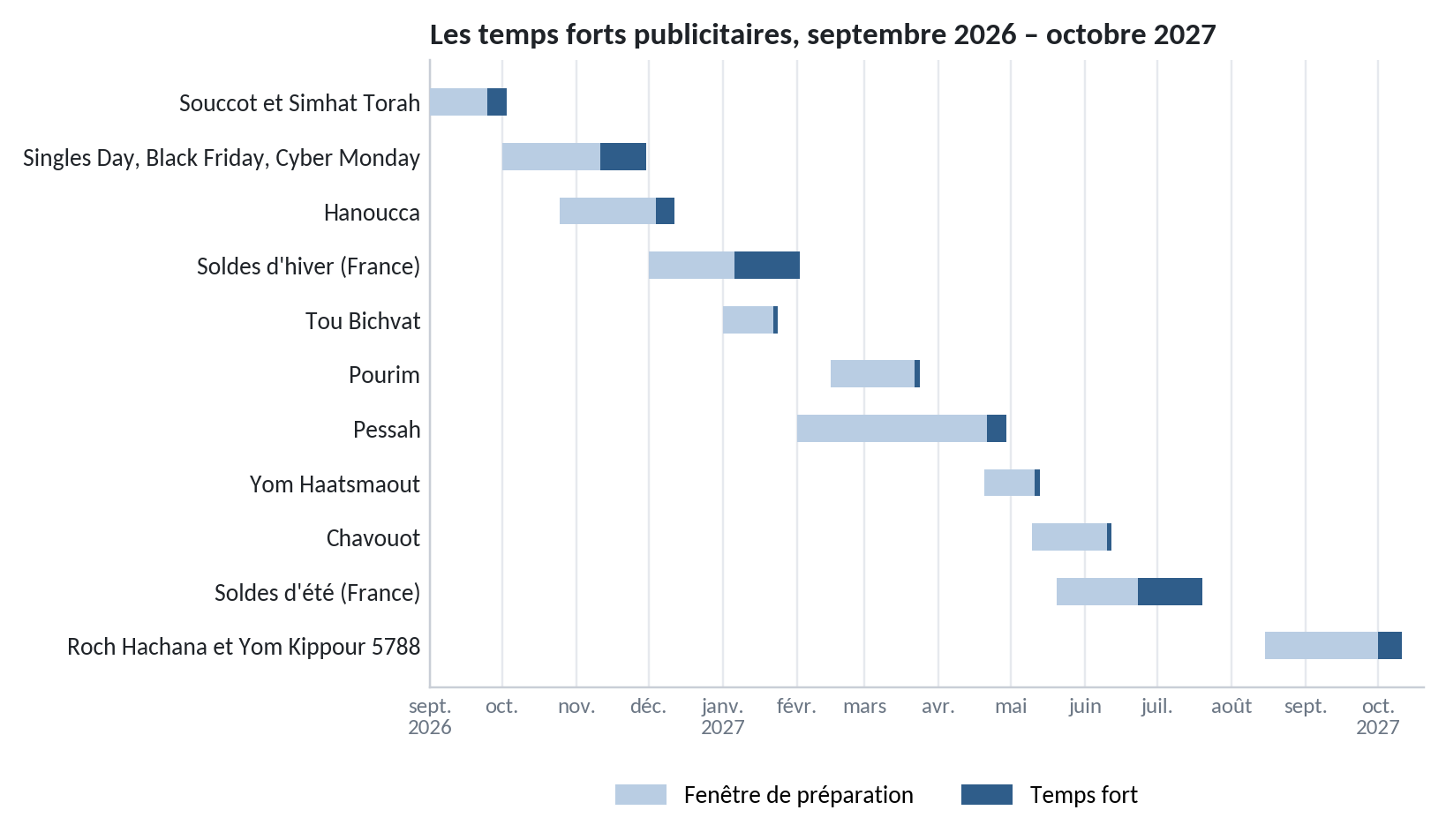
Advertising peaks from September 2026 to October 2027 and their preparation windows (Hebcal dates and commercial calendar)
Shabbat: a calendar within the calendar
Even before holidays, the week sets its rhythm. From Friday afternoon to Saturday evening, much of Israel and part of France’s Jewish community disconnect. Activity resumes Saturday evening and Sunday, Israel’s first working day.
Three implications for campaigns:
-
Orders for Shabbat delivery are decided Sunday to Thursday. Urgency messages such as “order before Thursday noon” fit naturally
-
Leads received on Friday often wait until Sunday. Automatic confirmation limits the loss
-
Some businesses pause advertising during Shabbat. This is possible, but times change weekly and differ between Paris, Jerusalem and Tel Aviv. Scheduling needs careful maintenance
Tishrei: three weeks outside the usual rhythm
From Rosh Hashanah to Simchat Torah, Tishrei brings around three weeks of holidays. In 2026, that runs from the evening of 11 September to 3 October. Business slows, and “after the holidays” — aharei hachagim — becomes the nationwide answer to pending decisions.
What this means for campaigns:
-
For B2B lead generation, decisions pause. Reduce spend on holidays and prepare a restart the day after Simchat Torah
-
For e-commerce, the lead-up to Rosh Hashanah is a peak: food, wine, tableware, flowers and gifts. Israeli companies also give staff holiday gifts before Rosh Hashanah and Passover, creating a distinct B2B market
-
During Yom Kippur, the country stops. Promotions have no place that day
The numbers show the intensity: on the Friday before Rosh Hashanah 2026, card spend reached ₪459 million between 8am and 11am, up 2.7% year on year, according to The Jerusalem Post. Holiday-product inflation contributed substantially.
The practical approach: start preparing Rosh Hashanah in late July, with creatives and stock ready by mid-August. In 2027 it falls on 2 October, giving three extra preparation weeks versus 2026.
November: Israel’s shopping season
Israel has adopted global online-shopping events and turned them into a full season.
-
Singles Day, 11 November, originating in China, draws Israelis to AliExpress, Amazon and major international platforms
-
Shopping IL, launched by Google around twelve years ago, promotes local online retail throughout November
-
Black Friday, 27 November 2026, remains the year’s peak
-
Cyber Monday, 30 November 2026, extends the event online
Shva, Israel’s national card-payment system operator, reported ₪1.198 billion in Black Friday 2024 card spending, up 8.7% from 2023. Electronics rose 34.8%, clothing and footwear 11.9%.
What this means for campaigns:
-
Build audiences in October : site visitors, video viewers and offer waitlist subscribers
-
Ramp up gradually. A sudden budget jump the day before Black Friday often restarts Meta learning at the worst moment
-
Expect stronger advertising competition : impression costs rise when every brand bids at once
-
Remember customs. ICL Global says Israel’s personal-import VAT exemption returned to $75 on 2 June 2026. For French stores shipping to Israel, baskets above that threshold incur 18% Israeli VAT. State the final price clearly or checkout abandonment can cost more than the discounts.
Hanukkah: eight days, not one
Hanukkah 2026 runs from the evening of 4 December to 12 December: eight candle-lighting evenings, eight opportunities to engage customers, and Israeli school holidays that make it family time.
In Israel, Hanukkah naturally extends November’s season: toys, games, books, family outings, doughnuts and treats. An eight-day content or offer calendar works better than one promotion.
In France, Hanukkah overlaps Christmas shopping. Ad auctions are among the year’s most competitive, and Judaica, kosher food and gift brands compete with unrelated giants. The response:
-
focus spend on existing customers and lists, with Hanukkah-specific creatives,
-
let creative select your audience rather than relying on massive spend,
-
anticipate delivery deadlines and year-end postal delays
From Tu Bishvat to Purim: the winter interval
Tu Bishvat, 23 January 2027, creates a small opportunity for dried fruit, gift boxes and nature-related products.
Purim, 23 March 2027, is an underestimated peak: Israel’s costume season for children and adults, and a time for mishloach manot gift baskets everywhere. Purchases are planned two to three weeks ahead, so campaigns should start in late February.
In France, January is the four-week winter sales period. Franco-Israeli brands can clear French stock while Israel has a quieter period.
Passover: the peak prepared in winter
Passover 2027 starts the evening of 21 April and ends on 28 April in Israel, 29 April abroad. It mobilises some of the year’s largest household budgets.
In Israel, Passover triggers purchases of cleaning products, tableware, clothing, food, corporate gifts, outings and trips during Chol Hamoed. Business slows significantly. Reduce lead-generation budgets during the holiday and prepare the restart.
Within the French community, some sectors prepare Passover very early:
-
Passover holidays at kosher hotels and programmes in Europe, Israel or elsewhere sell months ahead. Start campaigns in autumn with location videos and previous-customer lists
-
Kosher caterers and shops use order forms with deadlines: reminders in March, urgency campaigns in the final ten days
-
Judaica such as Seder plates, Haggadot and gifts follows a four-to-six-week cycle
Spring and summer: Independence Day, Shavuot and school holidays
Israeli spring combines days with very different moods, which must be respected.
-
Yom Hashoah, 4 May 2027, and Yom Hazikaron, 11 May, are remembrance days. Pause promotions or use a restrained, respectful tone
-
Independence Day, 12 May, brings barbecues, outings, flags and festive offers. The move from mourning to celebration happens within hours: time creatives carefully
-
Shavuot, 11 June 2027, is associated with dairy products, cheesecake and flowers: a short, focused food-marketing window
Summer brings Israeli school holidays and overseas trips. France’s summer sales begin in late June, followed by a B2B slowdown in August. Tisha B’Av, 12 August 2027, is a day of mourning: community brands avoid festive messaging.
Days when silence is better
Some dates require silence or restraint. A promotional ad that day does more than underperform: it damages your image within a community that remembers.
-
Yom Kippur,
-
Yom Hashoah and Yom Hazikaron,
-
Tisha B’Av,
-
security tensions, when cheerful promotions can offend
Prepare a protocol: pause rules, neutral replacement creatives and someone authorised to decide quickly.
The method: four-stage backward planning
Prepare each peak the same way, adjusted to your buying cycle.
-
45 days before: foundations. Offer, stock, logistics deadlines, landing pages and creatives in each language. Check conversion tracking too
-
21 days before: warm-up. Awareness and content campaigns, retargeting audiences and an offer waitlist
-
Final seven days: acceleration. Gradual budget increases on winners, retargeting, urgency and delivery-deadline reminders
-
Days 1–7 afterwards: exit. End promotions, analyse results and retarget non-buyers with an evergreen offer
Avoid repeated abrupt Meta budget increases: significant edits restart learning, generally requiring around fifty optimisation events to stabilise. Our Israel scaling article explains the right pace.
Allocate budget around a peak
Putting everything into the big day is tempting, but rarely optimal. Buyers decide earlier than expected, and last-day auctions are expensive.
A useful allocation, adapted to your cycle:
-
a preparation share, across the preceding three weeks, building awareness and audiences,
-
the main share in the final days, through retargeting and proven campaigns,
-
a small reserve, to reinforce what works rather than fixing every allocation upfront
After the holiday, remove promotional messaging promptly but retain evergreen retargeting: holiday visitors are among your most qualified audiences of the year.
Compare each peak year on year using relative days — 30 days before, seven days before and the day itself — rather than calendar dates. With moving holidays, this is the meaningful comparison.
Two calendars for Franco-Israeli businesses
Overlay the calendars month by month when selling in both markets. Conflicts become obvious.
| Month | Israel | France |
|---|---|---|
| September–October | Tishrei holidays, slower activity | Back-to-school, normal activity |
| November | Singles Day, Shopping IL, Black Friday | Black Friday and Christmas preparation |
| December | Hanukkah and school holidays | Hanukkah during Christmas season, expensive auctions |
| January–February | Quiet period, Tu Bishvat | Winter sales |
| March–April | Purim, then Passover | Purim and Passover in the community |
| May–June | Memorial days, Independence Day and Shavuot | May long weekends, summer sales in late June |
| July–August | School holidays and travel | Sales, then the August slowdown |
This comparison guides allocation. In December, an Israeli shekel may outperform a French euro as Christmas drives auctions up. January sales may reverse it. Separate country reporting is the only way to verify your own results.
Frequently asked questions
Should you stop advertising during holidays?
Not automatically. E-commerce often peaks before holidays and slows on the days themselves. Lead prospects are less available and may wait days for a call. Reducing budgets is generally better than stopping entirely.
Does Black Friday suit a community brand?
Yes, if it complements your calendar. Judaica or kosher brands often benefit from linking November offers to Hanukkah gifts in December.
In summary
-
The Hebrew calendar moves every year : reset plans using official dates each year
-
Tishrei pauses B2B and drives holiday shopping; Rosh Hashanah 2027 is three weeks later than in 2026
-
November has become Israel’s main online-shopping season: ₪1.198 billion in card spend on Black Friday 2024
-
Hanukkah lasts eight days and competes with Christmas auctions in France
-
Passover requires autumn preparation for travel, four to six weeks for food and gifts
-
Some days call for silence : plan for them in advance
Further reading
Sources
-
Hebcal — Jewish Holidays 5787 (2026–2027)
https://www.hebcal.com/holidays/2026-2027 -
Hebcal — Jewish Holidays 5788 (2027–2028)
https://www.hebcal.com/holidays/2027-2028 -
Israel National News — Black Friday 2024: Israelis spend NIS 1.2 billion (November 2024, Shva data)
https://www.israelnationalnews.com/news/400053 -
The Jerusalem Post — Here it comes: From Black Friday to Cyber Monday, all the shopping month events (2025)
https://www.jpost.com/consumerism/article-872803 -
The Jerusalem Post — Supermarket aisles seen quieter than expected ahead of Rosh Hashanah, despite NIS 500m. spent (September 2026)
https://www.jpost.com/business-and-innovation/article-908386 -
ICL Global — VAT Exemption Threshold for Personal Imports to Israel Updated (June 2026)
https://www.iclglobal.com/news_update/vat-exemption-threshold-for-personal-imports-to-israel-updated/ -
French Directorate-General for Enterprise — Sales dates
https://www.entreprises.gouv.fr/espace-entreprises/s-informer-sur-la-reglementation/les-soldes -
Meta Business Help Center — About the learning phase
https://www.facebook.com/business/help/112167992830700
