French buyers have long driven Israeli property demand, from Netanya and Ashdod to Jerusalem, Tel Aviv and Ra’anana. They are also among the country’s most heavily targeted audiences. Every developer approaches the same families in the same French cities with similar promises.
The result: cheap leads, empty viewing schedules and salespeople calling casual browsers all day. Generating French-buyer leads is easy. Finding buyers capable of signing is harder.
Here is the method, from qualification to callbacks and from advertising to twelve-month follow-up.
A changing market with arriving buyers
Context shapes your messaging. Israel’s CBS data, reported by The Times of Israel, showed house prices up 0.1% in May–June 2026 versus the preceding two months, but down 1.5% year on year. Prices had fallen in eight of the previous twelve months.
Transactions are recovering: 8,757 homes sold in June 2026, up 50% year on year, including 3,593 new homes, up 84%.
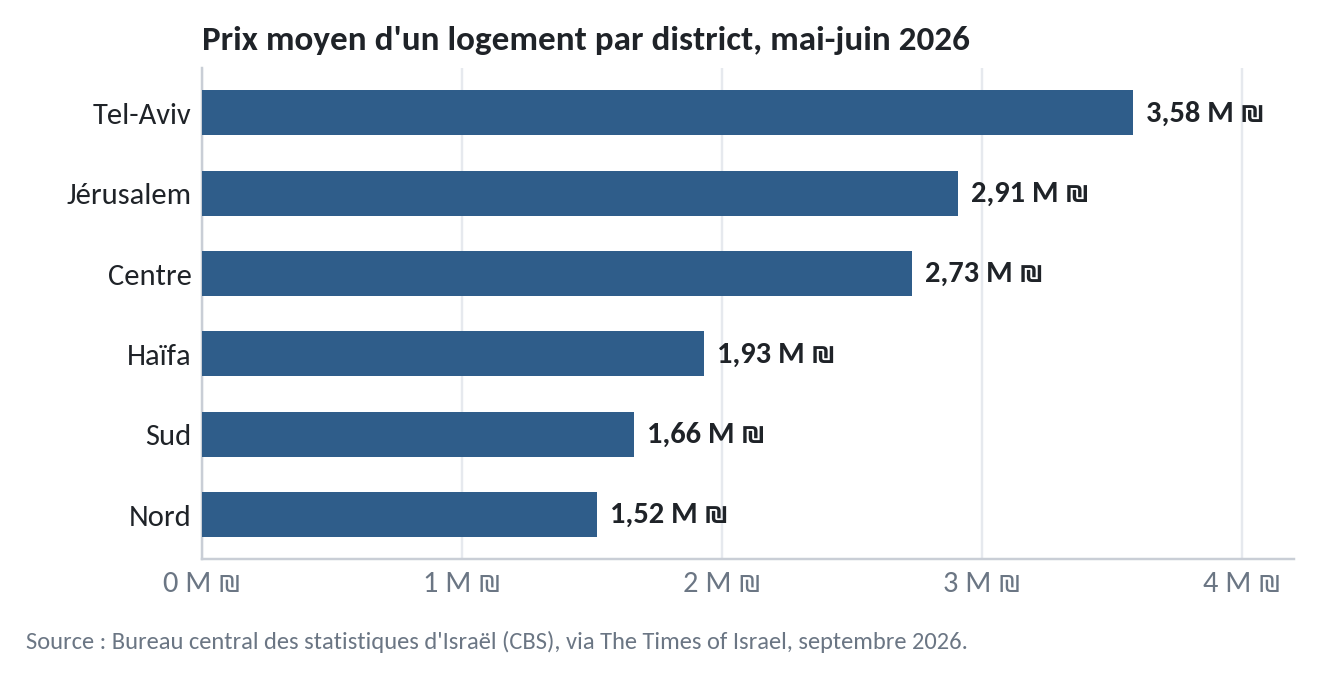
Average home price by district, May–June 2026, in millions of shekels (CBS, via The Times of Israel)
French immigration remains strong: 3,357 arrivals in 2025 and around 2,400 from January to late July 2026, according to The Times of Israel. Every family planning its move eventually becomes a buyer or tenant.
Differences are substantial: an average home costs more than twice as much in Tel Aviv as in the North. These figures help you define realistic city-specific budget ranges in your forms.
Calmer prices, more transactions and sustained French demand: acquisition quality now separates developers who sell from those who wait.
Three buyers, three messages
There is no single “French buyer”. There are at least three profiles, each requiring different messaging, qualification and timing.
| Profile | Trigger | Decisive qualification question | Typical timeframe |
|---|---|---|---|
| The future immigrant | Immigration date and children’s schooling | “When do you plan to move?” | Aligned with immigration |
| The investor | Returns, diversification and inheritance planning | “How much equity can you provide?” | Variable, often faster |
| The holiday-home buyer | Family holidays, parents and vacations | “How many weeks a year will you use it?” | Long, highly emotional |
The future immigrant
They are buying a main residence and a new life: school, synagogue, community and commute. Discuss neighbourhoods, French-speaking neighbours and delivery dates compatible with their arrival.
Financing also differs. Mizrahi-Tefahot says foreign buyers are generally limited to 50% financing, while those eligible for Israeli citizenship may obtain up to 75% for a first home. This is both a selling point and a qualification question.
The investor
Investors compare rental yield, taxation and acquisition costs. Additional-home purchase tax (mas rechisha) is 8% up to ₪6,055,070 and 10% above it, under a schedule extended to 31 December 2026. Non-residents should have a lawyer assess their situation: these rules materially affect the calculation.
Talk numbers, not dreams, and quickly connect them with someone who can answer legal and tax questions.
The holiday-home buyer
Holiday-home buyers purchase for Passover, Sukkot or summer, to be near children already in Israel or ageing parents. The decision is emotional and develops slowly. Discuss use: views, beach or Old City access, and management while absent.
The rule arising from these profiles: one form, one ad and one call script cannot persuade three such different people.
What French buyers fear, and how your ads can address it
Buying 3,000 kilometres away, in another language and legal system, creates specific fears. Ads that ignore them attract clicks. Ads that address them attract buyers.
-
Fear of fraud. Provide transparency: developer name, completed projects, permit number, site address and team faces. Nefesh B’Nefesh explains that Israel’s 1974 apartment-sales law prevents developers taking payments without a prescribed safeguard, usually a bank guarantee. Say so clearly
-
Fear of delays. Delivery delays are a legitimate concern. Show actual construction progress in dated photographs
-
Fear of unfamiliar law. Introduce the buyer’s lawyer, preferably French-speaking, and outline the transaction stages
-
Fear of exchange-rate changes. A euro budget paid in shekels moves with exchange rates. Show both amounts and explain the payment schedule
-
Fear of remote management. For investors and holiday-home owners, who handles rental, maintenance and charges? A practical answer is stronger than a slogan
Each concern can become a creative angle. A two-minute lawyer video explaining safeguards reassures more than another 3D rendering.
Qualify before spending: the form is your first salesperson
An unqualified lead costs twice: the lead price, then the salesperson’s time. Qualification therefore starts in the form.
Questions that genuinely qualify:
-
The project: main residence, investment or holiday home
-
Budget, in ranges, in shekels and euros to prevent conversion errors
-
Available equity, considering financing rules
-
Timeframe: under six months, six to twelve months or over a year
-
Preferred cities
-
Immigration plans, including the date where relevant
Choose Meta’s higher-intent instant form, which adds a review screen. Volume falls and quality improves. A multi-step website form has a similar effect.
An important legal point: these prospects live in France. GDPR applies to their data, and CNIL says email or SMS marketing to individuals requires prior consent. Include an unchecked-by-default box authorising follow-ups.
Meta creates demand; Google captures it
Meta: reach people who have not searched yet
Most future buyers have not searched Google yet. They think about it, discuss it at dinner and see friends’ posts from Israel. Meta reaches them at that stage.
-
Target France broadly, and let the creative filter. Meta removed religious targeting in 2022. A project visual, a French headline about life in Netanya or Jerusalem, and prices in euros and shekels select better than an interest
-
Prioritise video : a site tour, balcony view, eye-level neighbourhood footage or a developer speaking French to camera
-
Show evidence : completed projects, French families already settled, bank guarantees and construction schedules
-
Check the ad category. Depending on target countries, Meta requires the special Housing category, restricting age, gender, location and lookalike targeting. Check this for every campaign
Google: capture people already searching
Searches exist in modest volumes: “apartment for sale Netanya”, “new property Jerusalem”, “buy an apartment in Israel”, your development name or company name. These people have clear intent. Their leads cost more and are worth more.
-
Use French searches, plus English for some investors
-
Avoid fragmenting campaigns: with low volumes, too many ad groups prevent learning
-
Send users to a French page for each project, with plans, prices, timelines and WhatsApp contact
The landing page: a visit before the visit
A buyer in Paris cannot walk past the building site. Your page must act as a first viewing. Create one French page per development, with:
-
prices in euros and shekels, and the payment schedule,
-
floor plans, by property type, with areas and orientations,
-
a neighbourhood map : schools, synagogues, shops, beach, transport and journey times to Tel Aviv or Jerusalem,
-
the construction schedule, and actual progress,
-
safeguards offered to the buyer, explained simply,
-
a short video of the developer or French-speaking adviser,
-
testimonials from French families already settled,
-
a WhatsApp button clearly visible alongside the form
The page must load fast on mobile: most prospects discover it on their phones between other commitments.
Callback speed makes the difference
Property leads cool within hours. Harvard Business Review’s study of 2,241 companies found contact within an hour was nearly seven times more likely to qualify a lead than waiting one hour longer.
The France–Israel scheduling gap complicates matters, but also creates an opportunity:
-
Sunday is a working day in Israel and a day off in France. It is often the best time to reach a relaxed, available French buyer
-
Evenings in France, prospects are at home. Israel is one hour ahead: plan callbacks until 9pm Paris time
-
Friday afternoons and Shabbat, schedule an automatic acknowledgement stating when you will call
First contact should be in French, from someone who knows the development, neighbourhood and process. WhatsApp is ideal for sending plans, brochures and video immediately after the call.
The long cycle: twelve-month follow-up without fatigue
Most French buyers do not sign within a month. They consider, visit during a trip and discuss with family. A cold March lead may sign in November if you stay present without becoming intrusive.
A sequence that works:
-
Day 0: call, then send documents on WhatsApp
-
Day 2: a follow-up message with personalised answers to their questions
-
Week 1: offer a video viewing or an in-person visit during their next trip
-
Every month: a useful, non-promotional update: construction progress, market news, tax questions or a settled buyer’s story
-
Every quarter: a live webinar with a lawyer and mortgage adviser to answer legal and financing questions
-
Before holidays: an invitation to visit during Sukkot, Passover or summer, when many French families travel to Israel
Meanwhile, Meta and YouTube retargeting keeps the project visible to video viewers, page visitors and people who opened but did not submit your form.
Connect digital campaigns with fairs, trips and events
Franco-Israeli property also happens offline: Paris fairs, community information meetings and scouting trips to Israel. Connect these events with your campaigns.
-
Before the event, fill the room with Meta: form registrations and a WhatsApp reminder the day before, with consent
-
During it, collect contacts through the same form as your ads so they reach the same CRM with the same qualification questions
-
Afterwards, retarget stand visitors and absent registrants with a recap video and an offer to visit Israel
An unconnected fair produces a stack of business cards. A digitally connected one creates an audience you can engage for months.
How much should a development invest?
Work backwards from homes to sell to French buyers. Here is an example with illustrative rates:
| Calculation step | Assumption | Result |
|---|---|---|
| Homes to sell to French buyers | 20 | 20 target sales |
| Qualified-lead close rate | 1 in 25 | 500 qualified leads required |
| Qualified share of total leads | 30 % | around 1,670 leads |
| Cost per lead | 90 ₪ | around ₪150,000 in media spend |
Spread this budget across the sales period, often more than a year. Relative to development margin it remains modest, provided every funnel stage is managed. If slow contact halves the close rate to 1 in 50, the required budget doubles.
Replace these assumptions with your own figures in the first weeks. Set an acceptable cost per sale from the start and manage against it.
Measure what really matters
CPL is a starting metric, not the final one. Track:
-
cost per qualified lead against your written criteria,
-
cost per appointment, online or in person,
-
cost per actual viewing in Israel,
-
cost per reservation, then per signed contract
Link every lead in your CRM to its source, campaign and creative. Send statuses back through Meta’s Conversions API and Google enhanced conversions for leads. Google uses hashed data such as email addresses to connect offline sales to the original ad. Across a months-long cycle, this teaches algorithms to find buyers rather than dreamers.
Platform attribution windows are short compared with your sales cycle: days after a click versus months to close property sales. Ad reports therefore understate campaign impact. Only a CRM retaining each buyer’s original source gives the full picture.
The most expensive mistakes
-
Optimising for CPL, rewarding campaigns attracting casual interest
-
One form for three profiles, forcing sales to qualify everything again by phone
-
Unrealistic “from” prices, producing disappointment on the first call
-
A salesperson who does not speak French, or does not know the development
-
Calling the next day, or after Shabbat
-
Giving up after thirty days, when the decision cycle lasts months
-
Focusing only on Paris, while buyers also live in Marseille, Lyon, Nice, Strasbourg and Toulouse
Frequently asked questions
Should ads be restricted to cities with large Jewish communities?
Not necessarily. Narrow geography reduces audiences and raises costs. Let creative select the public, using geography for practical reasons such as holding a local information meeting.
Do French buyers need Hebrew ads?
No. They read French and expect a French-speaking contact. Hebrew comes later for administration and everyday life. Use it for campaigns targeting the Israeli market.
In summary
-
Three buyer profiles, three messages : future immigrant, investor and holiday-home buyer
-
Qualify in the form : project, budget, equity, timing, cities and immigration date
-
Meta creates demand, Google captures existing demand: they complement each other
-
Call back within an hour, in French, and make use of Sundays
-
Follow up for twelve months, with useful content and regular touchpoints
-
Measure through to the contract, and send quality feedback to the platforms
Further reading
Sources
-
The Times of Israel — Housing snapshot September 2026: Prices inch upward after sharp decline (September 2026)
https://www.timesofisrael.com/housing-snapshot-september-2026-prices-inch-upward-after-sharp-decline/ -
The Times of Israel — 128 immigrants arrive from France, as French aliyah sees continued growth (July 2026)
https://www.timesofisrael.com/liveblog_entry/128-immigrants-arrive-from-france-as-french-aliyah-sees-continued-growth/ -
Mizrahi-Tefahot — Q&A: Mortgages in Israel
https://www.mizrahi-tefahot.co.il/en/about-mizrahi-tefahot/qa-mortgages-in-israel/ -
Barnea Jaffa Lande — January 2025: Legislative amendments to real estate taxation in Israel
https://barlaw.co.il/… (lien complet) -
CNIL — Direct marketing by email, SMS/MMS and automated calls
https://www.cnil.fr/fr/la-prospection-commerciale-par-courrier-electronique-sms-mms-et-automate-dappel -
Jon Loomer Digital — Special Ad Categories: A Guide for Meta Ads
https://www.jonloomer.com/special-ad-categories-meta-ads/ -
Harvard Business Review — The Short Life of Online Sales Leads (March 2011)
https://hbr.org/2011/03/the-short-life-of-online-sales-leads -
Google Ads Help — About enhanced conversions for leads
https://support.google.com/google-ads/answer/15713840?hl=en -
Nefesh B’Nefesh — Buying an Apartment on Paper: Protect Your Money
https://www.nbn.org.il/life-in-israel/community-and-housing/buying-and-renting/buying-an-apartment-on-paper-protect-your-money/
