“My leads cost ₪150. Is that expensive?” As phrased, the question has no answer. Lead cost is neither good nor bad in isolation. It depends on three figures specific to you: margin, sales conversion rate and the proportion of leads your team can actually reach.
Market benchmarks are useful if read correctly. This article presents the strongest published references, explains why Israeli results differ, and shows how to calculate the point at which a lead stops being profitable.
Why online “average CPL” figures mislead
Most circulating figures have four problems.
-
They mostly come from the United States. Major benchmark studies examine US campaigns, with different costs, competition and buying behaviour
-
They combine fundamentally different types of “lead”. An instant form completed in two seconds, a phone call and a WhatsApp click all count as leads
-
An average conceals the differences. Between law firms in Tel Aviv and Ashdod, or premium and introductory offers, costs can vary fivefold
-
They ignore quality. An unreachable lead costs as much as one who signs. Dashboards do not distinguish them
Israel adds its own constraints. It is a small country: Facebook reached 5.05 million users in October 2025, according to DataReportal. Audiences tire quickly. French-language targeting narrows the pool further, while all your competitors approach the same families.
Published benchmarks by sector
Without a public Israel-specific benchmark, WordStream and LocaliQ offer the strongest reference. Their studies cover US campaigns: use them for relative differences between sectors and platforms, not as prices to replicate.
| Sector | Google Search CPL (April 2025–March 2026) | Meta CPL, lead campaigns (April 2024–June 2025) |
|---|---|---|
| All sectors | 66,69 $ | 27,66 $ |
| Property | 102,51 $ | 16,61 $ |
| Lawyers and legal services | 131,63 $ | 18,17 $ |
| Finance and insurance | 74,44 $ | not published |
| Education and training | 77,48 $ | 28,22 $ |
| Health and fitness | 67,36 $ | 52,98 $ |
| Dentists | 72,97 $ | 76,71 $ |
| Home improvement | 90,92 $ | 41,26 $ |
| Business services | 93,69 $ | not published |
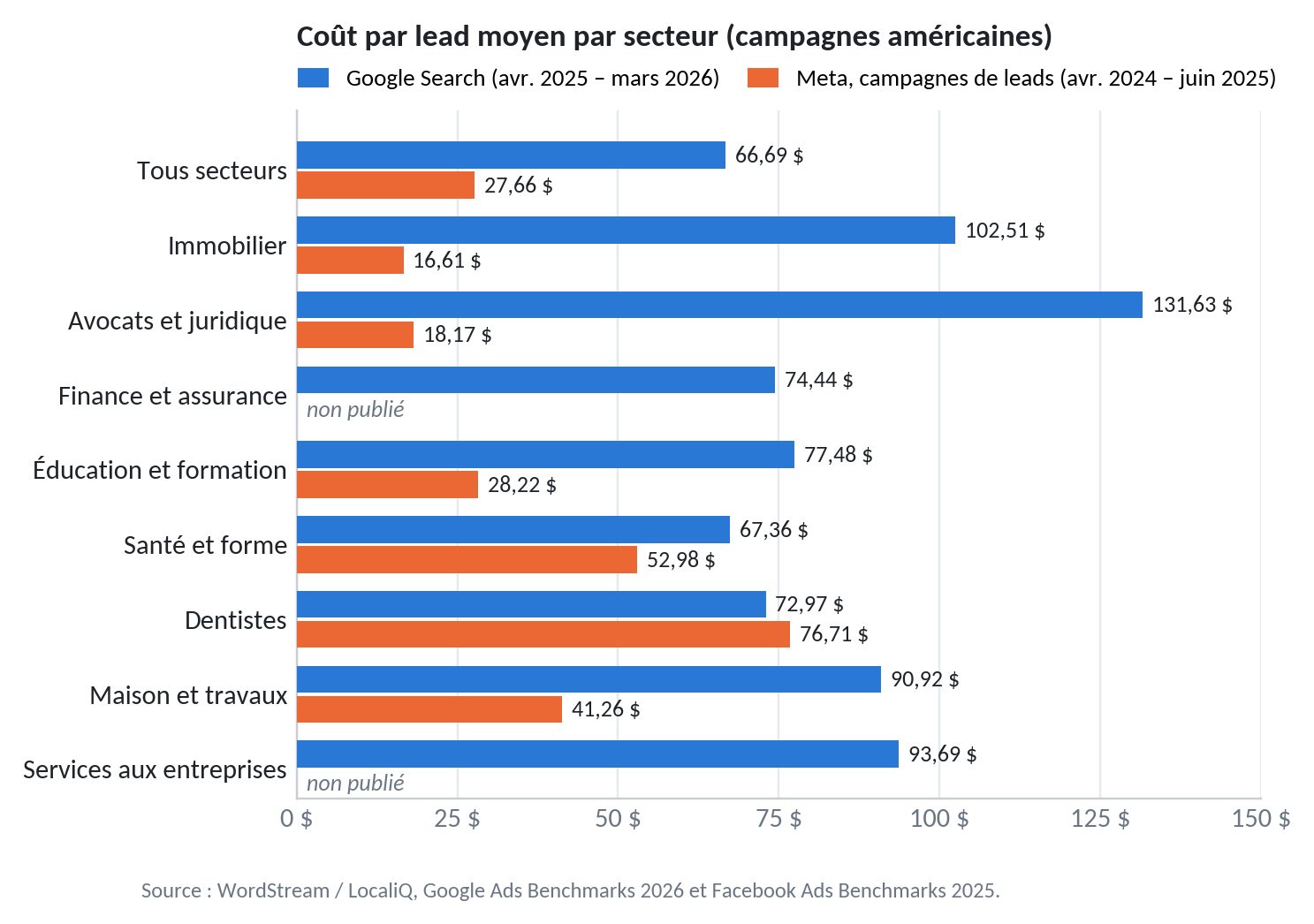
Average lead cost by sector, Google Search and Meta (US, WordStream / LocaliQ)
Three lessons emerge:
-
Meta produces much cheaper leads than Google in most sectors. In property, the gap reaches sixfold. These are different leads: on Google the person was searching; on Meta they were interrupted. Their intent is not equally strong
-
Trends diverge. Meta’s average lead cost rose 20.94% in a year. Google’s fell for the first time in five years, according to the latest study
-
Healthcare is an exception. For dentists, Meta costs more than Google. Highly regulated or competitive sectors do not follow general rules
Meta or Google: two lead types, prices and purposes
Comparing Meta and Google lead costs directly makes little sense. The platforms do not sell the same thing.
Google captures demand that already exists. Someone searching “divorce lawyer Netanya” or “health insurance for immigrants” has a need, often urgent. The lead is expensive but warm. French speakers add a challenge: many use Hebrew for local services and French mainly for France-related needs. French search volumes are low, so work on both keyword lists.
Meta creates demand that was not expressed. The person was scrolling when your ad caught their attention. The lead is cheaper but needs more work to convert: prompt contact, qualification and follow-up.
The question is therefore not “which platform has the lowest CPL?” but “which combination gives me the lowest customer cost?” For most services, both contribute: Google captures urgent, explicit needs; Meta expands the audience and builds future demand. They reinforce each other: someone who saw your Instagram ads is more likely to search your name on Google when the need becomes urgent.
Indicative ranges for the Israeli market
The figures below are indicative estimates in shekels. They are working ranges, not official prices or performance guarantees. Channel, timing, offer and qualification requirements can change them substantially.
| Sector | Language | Cost per lead | Cost per qualified lead | Comment |
|---|---|---|---|---|
| Property (French-speaking buyers) | French | ₪80–180 | ₪250–600 | Small audience, high potential value and a long decision cycle |
| Insurance and finance | French / Hebrew | ₪90–220 | ₪300–750 | Strong competition and demanding sales qualification |
| Legal services and accounting | French | ₪110–260 | ₪350–850 | Often strong intent, but limited French-speaking volume |
| Health and aesthetics | Hebrew | ₪70–170 | ₪220–520 | Creative, proximity and treatment type strongly affect cost |
| Training | French | ₪45–110 | ₪140–340 | Sensitive to price, the promise and commitment level |
| Services for immigrants | French | ₪55–140 | ₪180–450 | A closely connected but narrow audience that saturates quickly |
How to read them: CPL divides ad spend by leads received. Qualified-lead cost divides it by leads meeting written criteria set in advance — budget, timing, location and real need — verified by sales after first contact. Holiday periods are included because they are part of an advertiser’s real year in Israel.
These ranges are useful only when dated and sourced. A niche as small as French-speaking Israel changes quickly: immigration waves, a heavy-spending competitor or holidays can shift costs.
A lead is not the unit that matters
A lead is a promise, not a result. Between form and signature, contacts drop out at every stage: incorrect number, no answer, an immature project or an unsuitable budget.
Follow 100 leads bought at ₪80 each, using illustrative conversion rates:
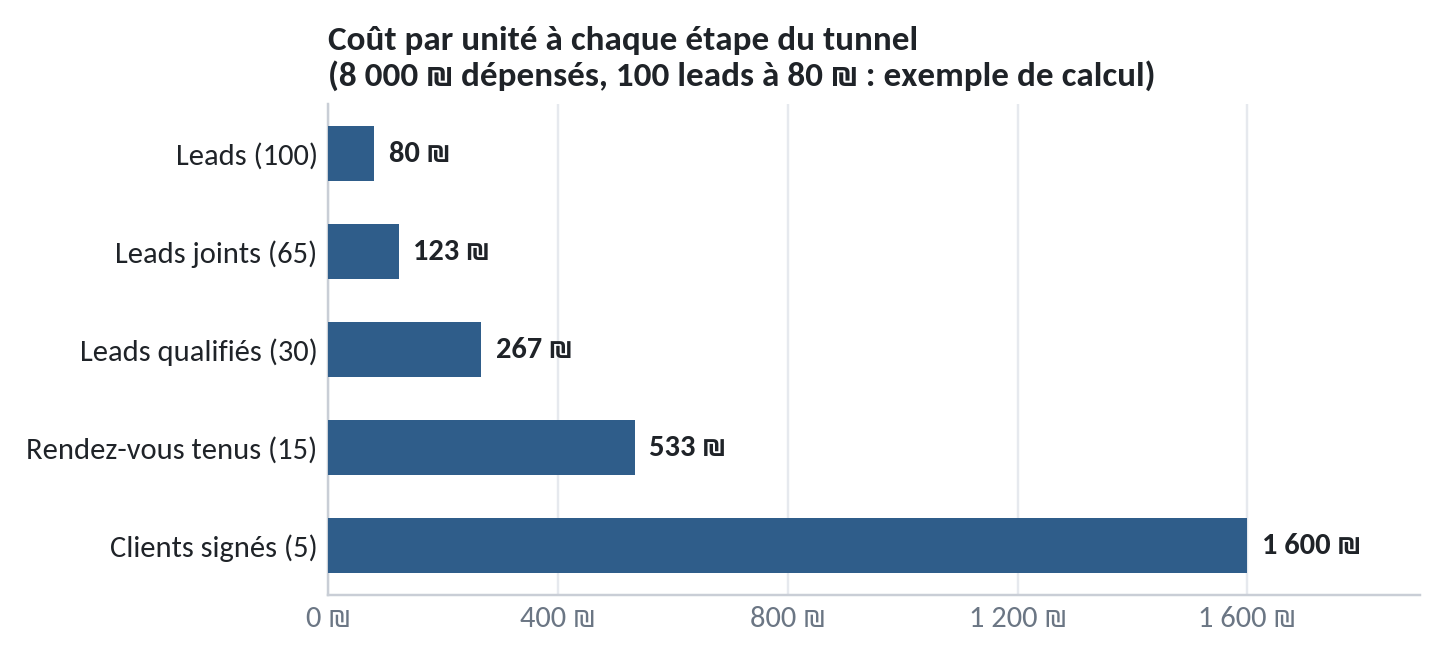
Funnel-stage costs for 100 leads at ₪80 (calculation example)
Of 100 leads, 65 are reached, 30 qualified, 15 attend appointments and five sign. The budget stays ₪8,000 at every stage; only the denominator changes. An ₪80 lead becomes a ₪1,600 customer, twenty times more expensive. Customer cost determines profitability.
The first loss — unreachable leads — largely depends on you. Harvard Business Review’s study of 2,241 companies found that contact attempts within an hour were nearly seven times more likely to qualify a lead than waiting an extra hour, and over 60 times more likely than waiting 24 hours or longer. Average response time was 42 hours; 23% never responded.
Israel’s Sunday–Thursday week, shorter Friday and Shabbat create 48-hour gaps. A Friday 2pm lead called on Sunday has cooled. When nobody can answer, an immediate confirmation stating the callback time limits the damage.
The particular economics of French-speaking leads
Israel’s French-speaking community relies heavily on referrals. People ask WhatsApp groups for a lawyer, broker or dentist before searching Google. This affects paid leads in three ways.
-
You are being compared. An ad-generated prospect often already has one or two recommended names in mind. Your callback must be faster and more reassuring than competitors’
-
Social proof is invaluable. French-speaking testimonials, immigrant-related situations and the founder’s story: what reassures people in a WhatsApp group also reassures them in an ad
-
Reputation travels fast. A badly treated prospect tells others. A well-received one recommends you, and that referral costs you nothing
A high CPL with an excellent referral rate may therefore be more profitable than it appears. The reverse is also true.
Six variables affecting your lead cost
1. The offer
What you ask of the prospect matters most. “Contact us” attracts little interest. A diagnosis, simulation, guide or free estimate attracts more, but not always the same people. Test several offers before deciding a channel does not work.
2. The form
Meta instant forms can favour volume or intent. The higher-intent option adds a review screen, reducing volume and improving quality. Extra questions raise CPL but often lower qualified-lead cost. A closed question such as “When would you like to start?” with three choices qualifies better than a free-text field nobody completes.
3. Language
There is no universal rule for French versus Hebrew. French reaches a narrower audience that may be less competitive or already saturated. Hebrew opens a larger, more competitive market. Only a structured test with separate language campaigns provides your answer.
4. Seasonality
Tishrei holidays, Passover, summer and security tensions all affect prospect availability. A CPL that doubles during Sukkot does not mean the campaign is broken.
5. Qualification
Well-chosen qualification questions — city, budget, timing and situation — raise CPL but lower qualified-lead cost. That is usually worthwhile. Sales also starts the call knowing the project’s readiness, location and budget. The call becomes a conversation rather than an interrogation.
6. Feedback to the platforms
If Meta and Google do not know which leads became customers, they find people who fill forms. Send lead statuses — contacted, qualified and customer — through Meta’s Conversions API and Google enhanced conversions for leads. Google matches hashed data, such as email addresses, to connect offline sales with the ads that generated them.
Calculate your maximum cost per lead
Rather than finding a “good CPL” in a study, calculate your own. You need just three figures.
Maximum CPL = margin per customer × share of margin allocated to acquisition × lead-to-customer conversion rate
Take a French-speaking law firm in Tel Aviv, using example assumptions:
-
average fee per case: ₪12,000,
-
margin per case: 60%, or ₪7,200,
-
share of margin allocated to acquisition: 30%, or ₪2,160 per customer,
-
one lead in twelve becomes a customer: an 8.3% conversion rate
Maximum CPL = 2,160 × 1/12 = ₪180.
At ₪150 per lead, the firm is profitable. At ₪220, it loses money unless conversion improves. That is often the real lever: improving from one customer in twelve leads to one in eight raises the ceiling to ₪270.
For recurring businesses — insurance, subscriptions or ongoing healthcare — use lifetime customer margin instead of margin on one sale. Your ceiling and bidding capacity increase.
Lower qualified-lead cost, not just CPL
-
Qualify in the form, with two or three questions removing unsuitable enquiries
-
Call back within an hour, in the prospect’s language, including Sundays for customers still in France, since Sunday is a working day in Israel
-
Automate initial contact when nobody can call: a WhatsApp confirmation sent with the prospect’s consent
-
Feed quality back to Meta and Google so their algorithms learn to find customers
-
Refresh creatives, because a small audience tires quickly
-
Exclude existing customers from acquisition campaigns
-
Test offers, not just visuals
The minimum measurement setup
None of this works without rigorous tracking. You do not need a complex tool: a well-maintained CRM is enough. For every lead, record:
-
source, campaign and creative,
-
ad language and first-conversation language,
-
receipt date and time, followed by first-contact date and time,
-
status: contacted, qualified, appointment, customer or lost, with the loss reason,
-
signed contract value, where applicable
A weekly review tells you more than any ad dashboard. It shows which campaigns produce customers, which attract curiosity, and how many leads are lost because contact came too late.
When a higher lead cost is good news
Rising CPL is not always a warning. If contact and close rates rise too, you may simply have stopped attracting casual interest. Adding qualification questions or optimising for qualified leads typically reduces volume, raises unit cost and lowers customer cost.
Never decide on CPL alone. Always examine cost per signed customer against the margin they generate.
Frequently asked questions
Are leads more expensive in Israel than France?
No robust public study supports that as a general rule. Differences depend on sector, language and competition. Israeli audiences, especially French-speaking ones, do saturate faster: costs rise sooner as budgets increase.
Should you buy leads rather than generate your own?
Third-party leads can be cheaper, but are often sold to several competitors. Check exclusivity, data origin and consent. Self-generated leads belong to you and train your own algorithms.
How many leads are needed to assess a campaign?
Enough that chance does not decide for you. A few dozen leads followed through the full sales cycle provide an initial reading. Judging ten leads is like judging a restaurant from one bite.
In summary
-
Published benchmarks, mostly from the US, put average CPL at $66.69 on Google Search and $27.66 on Meta, with substantial sector differences
-
These figures provide a sense of scale. Your profitable ceilingis calculated from your margin and conversion rate
-
The cost that matters is cost per customer. Response speed, qualification and platform feedback often matter more than click price
-
In Israel, the different working week, the holidays and thesmall French-speaking market require assessment across several weeks, never day by day
Further reading
Sources
-
WordStream / LocaliQ — Google Ads Benchmarks 2026 (13,474 US campaigns, April 2025–March 2026)
https://www.wordstream.com/blog/2026-google-ads-benchmarks -
WordStream / LocaliQ — Facebook Ads Benchmarks 2025 (US campaigns, April 2024–June 2025)
https://www.wordstream.com/blog/facebook-ads-benchmarks-2025 -
Harvard Business Review — The Short Life of Online Sales Leads (March 2011)
https://hbr.org/2011/03/the-short-life-of-online-sales-leads -
Google Ads Help — About enhanced conversions for leads
https://support.google.com/google-ads/answer/15713840?hl=en -
DataReportal / Kepios — Digital 2026: Israel (November 2025)
https://datareportal.com/reports/digital-2026-israel
